
At Lakota Local Schools, educators talk a lot about being “future ready.” It is one of the school district’s four vision statements, a belief that all students should graduate prepared to tackle one of the 4Es in the real world: Enrollment in higher education, Employment, Enlistment or Entrepreneurship.
Indeed, it is one of the constant challenges for educators to convince students that what they learn in the classroom is necessary to survive and thrive in the world.
“Our mission is for kids to see the relevancy of what they are learning in school,” says Keith Koehne, Lakota’s executive director of curriculum and instruction.
Most schools, of course, make token efforts to meet that goal with guest speakers, field trips and some internships or shadowing.
But Lakota is paying more than lip service to making school relevant and meaningful. The largest suburban public school district in Southwest Ohio has launched a groundbreaking approach to help students connect the dots between academics and real world learning.
The initiative has grown out of Lakota being one of six districts in the country selected for the Real World Learning Challenge Collaborative. The Challenge is an effort from Digital Promise’s League of Innovative Schools, of which Lakota is one of 96 members, and is funded by a grant from the Chan Zuckerberg Initiative. The Challenge tasked the six districts to bring “authentic, life relevant opportunities to secondary education.” For the past 18 months, Lakota has worked to develop a number of initiatives and curriculum tools that will give teachers various ways to make real world connections.
Lakota administrators feel in the long run it adds up to a pioneering plan “to reimagine the high school experience for our students,” according to Superintendent Matthew Miller.
“The bottom line is for teachers to be able to create an opportunity for a single student, or a class, to be exposed to a field of study in the real world,” says Lindsay Ellis, an innovation specialist, who acts as a coach and facilitator between community resources, teachers and digital tools to bring real world opportunities to the classroom.
Koehne says the district meets regularly with the other schools in the collaborative to compare notes and to help define what real world learning means. “Teachers, of course, have a curriculum they have to teach. Now they have options for how to present those skills using real world applications,” he says.
Among the nuts and bolts in what Lakota is calling its Real World Learning Road Map:
• Commitment to providing 1,300 internships so every senior can have some sort of exposure and experience to a possible career path.
• Hired a strategic partnership coordinator to be a broker between the school and business community.
• Launched an online tool, similar to LinkedIn, where teachers and businesses can make connections. Teachers also can get lesson plans and project ideas using business resources.
• Compiled a database of over 200 business partners that teachers may reach out to for a job study, classroom project, job shadow, field trip or online call with an expert.
Koehne said the possibilities are endless for teachers to be creative in the classroom. “A chemistry teacher might like a chemist to come in and design a project for students. Perhaps it might be a P&G researcher working on soap properties. Or a business supply chain company could present a real problem, ask students to solve it and have them present it to an industry group. It’s all a lot more meaningful than listening to some lectures and writing a paper.”
Ellis says one example of the initiative last spring involved students in three classes devoting 20 percent of their time to a “passion project.” Similar to independent study in college, the effort saw students producing a wide array of projects involving cooking skills, musical projects and medical research, and one student who designed a roller coaster.
“Every step of the way we tried to connect students with people in the profession they were researching,” Ellis says.
Koehne says the business community has generally been receptive to the Lakota initiative. He points out the district changed the way it approached business leaders. “We have not always offered businesses options. We would just ask for time or money. Now we provide business leaders with a menu of ways we can work with them. We ask them to figure how they might want to interact with us.”
Cyber Academy to Innovation Hubs
Even before being selected for the Challenge Collaborative, Lakota has been an innovation leader. All student in grades 6-12 now receive an individual Chromebook. To further facilitate personalized learning through access to digital tools, the district has been transforming its media centers into “innovation hubs” in its schools. Yes, an innovation hub is what we used to call a library.
“We find digital libraries of the 21st century can foster collaborative learning, including creativity and communication, across every subject area,” Koehne says.
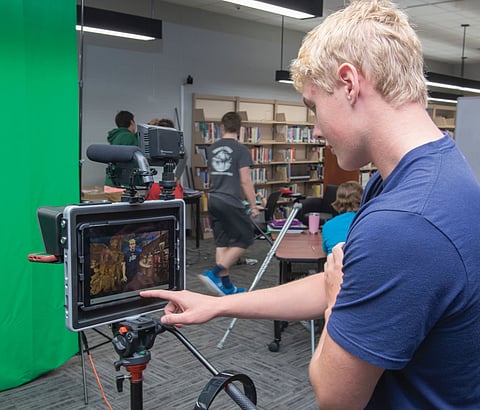
Ellis says the innovation hubs have a wealth of hi-tech tools to aid teachers in real world learning opportunities, including virtual and augmented reality stations loaded with educational videos, 3D printers, video and audio recording equipment, complete with green screen technology and video editing software.
This school year, Lakota is also launching its Cyber Academy with 150 students enrolled in what will be a series of classes that will lead to various industry certifications upon graduation. In a partnership with Belcan, the IT staffing and technical consulting giant, classes will cover basic network infrastructure, code writing and security issues, with more specialty areas to be added as students progress.
Administrators hope that utilizing real world problem solving and community partnerships will seep into the very fabric of the K-12 Lakota education experience. “You can lecture and test students and do that over and over. But now teachers can design curriculum that lets you present information in a real world experience. All the research shows information sinks in a lot better with that kind of authentic application.”
Ellis, the mother of three Lakota elementary children, thinks by the time her kids reach junior high school, their classrooms will operate very differently than she experienced less than a generation ago.
“I think these initiatives will produce students that are intrinsically motivated learners,” she says. “Studies show interest in learning falls off around fifth or sixth grades. We are definitely reimagining learning if we can get students to take more empowerment in their own education.”
For more information about Lakota Local Schools, call 513.874.5505,
visit www.lakotaonline.com, or follow #WEareLakota on social media.