
Q. Have your offices always been located downtown?
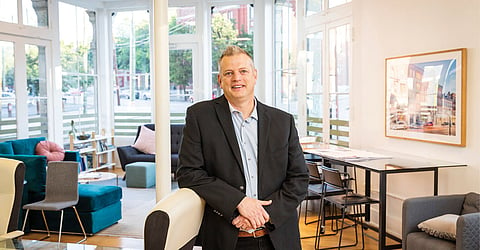
We are on our fourth office space, which is on Race Street in the Findlay Market area. We started out in the Pendleton neighborhood. We love being in the Over-the-Rhine Historic District and we plan to be here for a very long time.
Q. How important is it to be in the urban environment?
It’s critical. It’s part of our ethos to be a member of the communities and neighborhoods where many of our projects reside. That way, our work is personal. And we love being able to walk to Findlay Market or neighborhood eateries for lunch or happy hour with the team. We often invite our clients for a tour of our office (which is in a 150-year-old former tenement building we rehabilitated for a client) followed by project discussions and a quick bite or happy hour afterward. It’s important to us to be able to be good hosts to our clients, and our location helps us do that.
Q. Do you feel like you’ve influenced or mentored other architects?
I think so. Our office has a good mixture of both mature and younger staff, so cultivating a “learning studio” environment has been one of our core values since our founding. Veteran designers bring experience, knowledge and the benefit of having learned the lessons. They are good about pressing the pause button and saying, “This is a teachable moment,” or “Here is what we learned on this job site or project.” Younger designers bring fresh ideas and energy, newer digital skills and a different design aesthetic - a different ‘eye’ so to speak. They keep us from falling into a design rut and help our veteran designers identify newer trends. We all have something to teach and to learn.
Q. How did you decide to become an architect?
I always wanted to be an architect. My family was in contracting, development and construction when I was growing up, so I was always around primarily residential and multi-family job sites. Growing up in a ‘70s contemporary coastal ranch house my parents hired an architect to design and build was a huge influence. I never wanted to be anything else.
Q. How important is sustainability in your work?
Sustainability is a big part of our mission, but not so much in the way you might think. We are not as focused on seeking out sustainable products, although we certainly use them when we can and where it makes sense. We have a broader view of sustainability, especially in our rehabilitation projects. If a building is torn down, all the ‘embodied energy’ it took to create that building is now sitting in a landfill, wasted. So, we engage in the original model of sustainability: re-using, repurposing and renovating older and often vacant or derelict buildings and adapting them for modern use. That’s important to us.
When we do new builds — multi-family or affordable housing projects — they are often on sites that have been developed previously and are closer to the city center. So, rather than contribute to suburban sprawl, we help densify our community. Our mixed-use projects combine residential and commercial amenities. When doing work in the suburbs, we try to enhance walkability and live-work appeal. All of this results in fewer trips by car. So, for us, it is less about the products and more about the project type when it comes to our sustainability vision.
Q. What sets New Republic Architecture apart from other firms?
We offer our clients design without a sense of ego. Collaboration is another of our core values. Our clients are private developers; their projects are designed to be revenue generators for them, and we try to understand their point of view before we draw. Whether that’s an apartment building that must get leased up, a home that has to get sold, or an affordable housing project with people waiting to get into it, they all need to pencil out economically, as well as aesthetically and functionally. It’s a creative process, but the project must be financially viable, work for our clients, and for the end user communities.