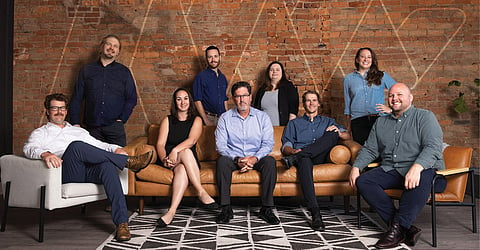

Hub+Weber Architects | Jim Guthrie | Principal-In-Charge
Covington, KY | 859-491-3844 |www.hubweber.com
Q. Your firm does a lot of commercial work, but you also do many residential projects. Do you have a preference?
We do a lot of multi-family residential and only a little single-family residential. The relative relationship between the fee and construction cost is higher with a single-family residential than it is with a commercial project. It’s often a smaller project but the same amount of work.
It’s hard for those building a $400,000 or $500,000 house to spend 10% on architecture. You have to understand the value we bring to a project and be willing to pay for that value. We do a lot of multi-family because we can spread our costs out. I admire folks who work in the residential market because the projects are so cool.
Q. Where do you find inspiration?
As an architect, many people have inspired and influenced me, from Frank Lloyd Wright to Zaha Hadid. That’s two different ends of the spectrum. Their work has challenged my perception of what architecture looks like. This understanding is reflected in our work. Look at our website and our project base. We don’t have a particular style because we always work toward our client’s vision.
Q. What sets you apart from other architecture firms in the area?
A small firm allows a client to engage with the firm’s principal. I am involved with all aspects of a project every day. That’s a distinguishing factor. I have a genuine stake in my client’s satisfaction. We also have a staff I’m proud of. Everyone works hard and does an excellent job. We go beyond our clients’ expectations.
Our commitment to diversity and inclusion in the profession also distinguishes us from other firms. It’s a substantive commitment, not merely a performative one. As a company, we aim to expand our project portfolio to support a broader range of individuals and promote greater diversity.
Q. Hub+Weber hosts special events and presentations, inviting the community to offer feedback on projects and other topics. Tell us more about that.
We’ve invited other architects into our office to give presentations, which might seem odd, but they are about topics I’m interested in. We had a presentation on aging and the impact of community on people regarding loneliness as you age and the importance of engaging with others. Another architect talked about research and discovery in architecture.
It’s about the concept of design, conversations about design, and binding clients with the community. We want to engage folks who want to think about opportunities in design and architecture. We are super proud of a presentation we just hosted. We invited six of our Latin architect colleagues into our office to give a presentation to the Latin community about opportunities in the profession. It was all in Spanish. The turnout was huge. A lot of interested high school students and their parents attended. It was the biggest event we’ve had at Hub+Weber.
Also, we have the largest badminton tournament in the area, now in its eighth year. It’s another way we engage our clients and community outside of the business of architecture.
Q. What trends are you seeing?
The challenge or obligation in retail is reinventing how you interact with your customers. Why go to a mall if you can buy anything you want or need online? Because shopping at a mall is an experience. It provides a connection. The pandemic taught us that we all need that kind of connection. But it’s about more than just going to the mall, the library or the pub. It’s having all these things in one space. How do you create one environment that supports connection and doesn’t just focus on consumer transactions? That’s where we are with a lot of different markets.
COVID, online shopping and social media have impacted everything. All of those things are contributing to the demise of the human condition. That’s where we, as architects, need to look for opportunities to engage folks and create environments for diverse engagement.
We are moving to downtown Cincinnati. As we get more work in Cincinnati, we want to grow our office from a space perspective, and we want the capacity to add staff. Having an office where I’m more engaged with the staff, have more room to grow, and have more room to host presentations is important.
It will be a good location — not so far from the Ohio River that we can’t see Covington and Newport because most everyone lives in northern Kentucky. That was super important in our decision, too. We also considered walkability.
Staying in one place too long can lead to complacency. Moving is good because it forces you out of what you know and makes you explore other things. It helps engage the brain. We’re looking forward to what’s next.