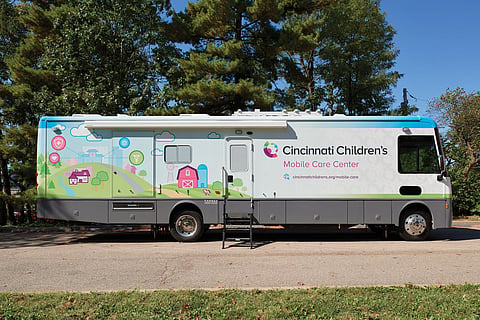

Through the new Cincinnati Children’s Mobile Care Center and a series of family health and nutrition videos, the Heart Institute is bringing pediatric heart care even closer to home.
As one of the nation’s top medical centers for pediatric heart care, Cincinnati Children’s Heart Institute serves patients from nearly all 50 states, not to mention the thousands who reside in Cincinnati and the tristate region.
In addition to full-service hospital campuses in downtown Cincinnati and Liberty Township, Cincinnati Children’s also offers outpatient services through a network of about 20 clinics throughout Ohio, Kentucky and Indiana. Even with that broad geographic network, the Heart Institute recognized it was not reaching a significant segment of the regional population — children from rural areas living more than two to three hours from the nearest clinic or hospital.
The Cincinnati Children’s Mobile Care Center aims to bridge that gap by traveling directly to patients and their families. Launched in November 2019, the center will deliver pediatric heart care and other pediatric services on a 38-foot-long handicap-accessible vehicle featuring two private exam rooms, medical and diagnostic testing equipment, laboratory testing capabilities and access to medical records for previous patients. The center began Heart Clinic
operations in Seaman, Ohio, a town in Adams County about 60 miles east of Cincinnati.
“The Mobile Care Center provides the exact same level of care that patients would receive in the hospital or in a bricks-and-mortar clinic,” says Andrew Redington, M.D., executive co-director of the Heart Institute and chief of pediatric cardiology at Cincinnati Children’s. “By bringing care to our patients, we’re providing a better service overall for them.”
Redington notes that if families have to drive more than an hour each way for a diagnostic or follow-up appointment — neither of which requires immediate care — they have to navigate time off work and figure out arrangements for other children who require care or transportation to and from school. For these families, traveling to Cincinnati often means that multiple children miss school and parents lose a day of work for a brief yet vital appointment that could take place closer to home.
“We have grown enormously over the last five years, seeing increasing numbers of patients from the tristate and beyond,” Redington says. “Our responsibilities require us to follow up with these children and families beyond just performing surgery. We are seeing more children coming to us from areas that were underserved in terms of medical facilities, and it created really onerous situations for parents and families to get the care their children need.
Local medical partners will work with Cincinnati Children’s to schedule Heart Clinic visits on the Mobile Care Center and notify patients when the Center and Heart Institute specialists will be in their area.
HEALTHY HABITS START AT HOME
Cincinnati Children’s is also expanding its outreach to families through the HealthWorks! video series, designed to promote better health and nutrition. After securing funding from a private donor, the team from Cincinnati Children’s Center for Better Health and Nutrition developed 26 videos to promote healthy eating and exercise.The videos are available on the Cincinnati Children’s YouTube page and the website for the Center for Better Health and Nutrition, the Heart Institute’s family-based program that targets weight management and obesity prevention.
As with the Mobile Care Center, the HealthWorks! videos are designed to supplement information given to children and families who visit the Center for Better Health and Nutrition clinics. They can also be used as a resource for children the team encounters during school and community events. Children and families with no connection to the program are also part of the target audience. The videos are fun and family-friendly with short soundbites of
information accessible to kids and caregivers alike.
“As a society, we’re really struggling,” says Kristin Stackpole, M.D., staff physician for the Center for Better Health and Nutrition. “The rate of obesity in 2- to 19-year-olds is 18.5% and 35% of kids 2 to 19 are overweight or obese. Many children also live in food deserts, in areas where there are no supermarkets or grocery stores for miles in which to purchase healthy foods. We’re hoping that our videos can help reach some of the children that we have not been able to reach through community events or our program.”
One concept the clinical team stresses for all children and families as they work toward healthier lifestyles is the 5-2-1-0 rule — five or more servings of fruits or vegetables daily, two hours or less of screen time, one hour or more for physical activity and zero sugary beverages.
“The focus of our videos and our program is health,” says Bob Siegel, M.D., medical director of the Center for Better Health and Nutrition. “Everyone should eat healthy foods, exercise and get enough sleep, regardless of their weight or their socioeconomic status. All of us need to work on this as a society. We all need to do better.”
To view the Healthworks! video series visit cincinnatichildrens.org/service/b/better-health/videos.