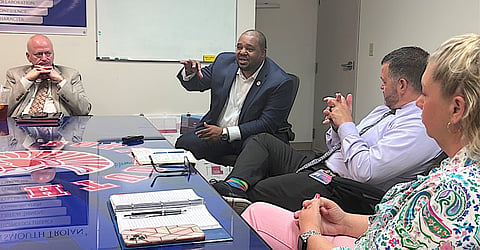

As student loan debt and forgiveness and the value of a college education are topics that continue to be hotly debated nationwide, Dr. K.L. Allen, Chancellor of the online, nonprofit Western Governors University Ohio (WGU Ohio), sees daily how online degree programs and competency-based education are bridging life’s gaps and building better opportunities for those who are wise enough to take advantage of them.
Recently, we caught up with Dr. Allen to get his thoughts on the current state of higher education and what it means to students coming from many different circumstances and experiences who are seeking success and exploring their potential.
VC: We live in a time where some are questioning the value of going to college, compared to the cost. What value do you see for the individual and for society?
Dr. Allen: Education is the driver of social mobility. I’m writing a book right now that offers my perspective as someone from rural America who happens to be Black, who happens to have a dad who was in law enforcement, and a mom who was a teacher for 30 years. Where I’m from, in North Carolina, it wasn’t about what color you were; it was more about socioeconomics. I’m of the firm belief that while we do have race problems in America, our biggest problem is socioeconomics. If you can afford to take care of your family and your needs, no one is really worried about what color you are. It’s all about whether you are a productive citizen and are afforded equal opportunity. Are you bringing something to the table?
Looking at the world, we tend to get stuck on the left or the right. Instead, let’s focus on what brings us together. We’ve got to depoliticize education. I was always taught that education should bring you together, but education looks different for different people. People do have different journeys and ways of getting there. Today, I don’t hear a lot of people saying they can’t wait to go to college, or “It’s going to change my life.” We’re trying to change that mindset and focus on outcomes that lead to jobs and support economic growth and prosperity.
VC: The expense of a college education varies so wildly. How do online colleges like WGU compare with the in-person options available at other schools?
Dr. Allen: We must make education more affordable. Not to knock any in-person school institution, but when your highest paid employee at a school is in the athletics department, I think you must ask, is your school focused on academics, or is it a school that’s a professional team disguised as an academic institution? That’s why tuition continues to increase. If you look at the landscape, it’s about the money, and who’s going to lose? The students, when they pay more for tuition.
At WGU, average tuition for undergrad is about $7,400 per year, and for a master’s degree, on average, it’s $7,800 a year. Our goal is to make education accessible as well as affordable. We don’t have football teams. We do have some offices, but that’s not where we do classes; those are 100 percent online. If you want the world to be better, you have to do something different.
VC: Tell us about the typical WGU student.
Dr. Allen: The average age of the WGU student is 33 in the state of Ohio and 37 nationally. Many of our students went to traditional colleges, and then life happened. Whether they had to return home to take care of family, someone got sick, or they had a child, they started working and realized they needed more. They returned to education to change their family legacy, to break some generational curses. What excites me most is that our student population is about 73 percent women. We have women graduating at historical rates, but there’s still that gap at the C-suite level for women and I ask why. There’s some research to be done there.
VC: The COVID-19 pandemic brought challenges and changes, both good and bad. What effects did you see at WGU and on higher education in general?
Dr. Allen: Being 100 percent online, we saw our enrollment soar. When I came aboard WGU Ohio on May 4, 2020, in the middle of COVID-19’s beginning phase, we had around 3,000 students and 4,300 graduates, and today we’re at over 5,200 students and over 10,000 graduates, which is a 53% growth in enrollment. We’ve had tremendous growth, which many educational leaders cannot say, especially at the rate we are seeing. It’s not that any school was prepared for the pandemic, but if one was, it had to be us because we were already doing it. COVID-19 proved our model that you need to have different modalities to be successful.
We were founded in 1997, and nationwide, to date, we have over 330,000 graduates. We will continue to increase, and even traditional schools will add more online options. COVID-19, as horrible as it was because we lost entirely too many lives, caused a lot of people in higher education to look at things differently. Going to school online used to be considered a joke or less rigorous. Now, most of us work from home or have a hybrid working arrangement. Some people may never have to return to a traditional office environment. Now, people see that you can be productive working from home. With online-based education, you can go at your own pace. A lot of people are having to make that choice — am I going to school or am I going to work? We’ve set it up so that you can do both and continue to take care of family responsibilities.
VC: How has rapidly developing technology affected higher education?
Dr. Allen: Some will tell you it is a moment of exhilarating promise and possibilities. Technology is enabling us to break the barriers of time and space to deliver quality instruction 24-7-365. But ChatGPT and other types of AI are also forcing us to look at education differently. We’re seeing more competency-based education models, something that was pioneered at WGU. Students are evaluated based on learning assessments of their skills rather than time spent in class, which allows them to move on from courses the minute they’ve proven their competency.
Higher education must keep up with technology, but the more important factor to me is that higher education has to keep up with the students. How do you keep up with the students holistically? What’s their outcome? New models are emerging that place students at the center of all we do.
To learn more about Western Governors University and its degree and certification programs in the fields of business, IT, education, and health and nursing, visit ohio.wgu.edu.